
Packed Bed Scrubber Applications — Industrial Acid Gas and Chemical Contaminant Removal
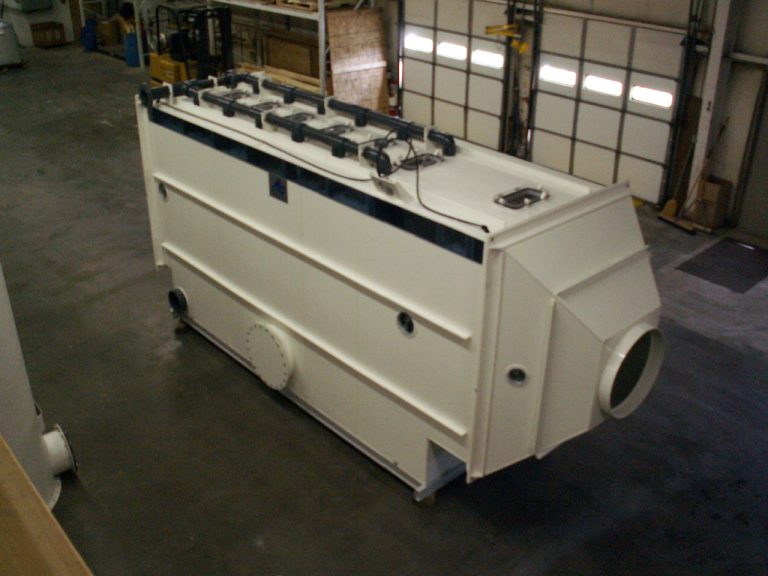
A packed bed scrubber is one of the most versatile and widely deployed wet scrubber configurations in industrial air pollution control. Mass transfer from the gas to the liquid phase happens across the wetted surface of a packed column — high surface area, countercurrent gas and liquid flow, and a residence time long enough for absorption to approach equilibrium. The configuration handles soluble acid gases and reactive gases at removal efficiencies routinely above 99% across a wide range of flow rates and inlet concentrations, with material selection that accommodates nearly every industrial chemistry.
Advanced Air Technologies’ Orion Series is a custom-engineered packed bed platform built in Polypropylene, PVC/CPVC, FRP, 304/316 stainless steel, and Hastelloy, in horizontal or vertical configuration, for continuous or intermittent duty. This guide walks through the six primary gas types the Orion handles — the chemistry, the scrubbing reagent, the typical industries, and the design considerations specific to each.
Primary Gas Types
Sulfur Dioxide (SO₂)
Sulfur Dioxide (SO₂) is a criteria pollutant regulated under the EPA National Ambient Air Quality Standards (NAAQS). It is generated in power generation, metal smelting, pulp and paper production, refinery operations, and any process involving sulfur-bearing feedstocks. It has a characteristic pungent odor and is corrosive to unprotected carbon steel equipment at elevated concentrations.
The standard scrubbing chemistry is neutralization with Sodium Hydroxide (NaOH):
SO₂ + 2 NaOH → Na₂SO₃ + H₂O
In a well-designed Orion packed tower, removal efficiency of 99% or higher is routine on SO₂. Scrubbing liquid pH is maintained around 9–10 to ensure the NaOH is in excess relative to the absorbed SO₂.
The AAT Apollo 250 installation at a southwestern oil refinery illustrates the upper end of SO₂ scrubbing service. The process involved spent-acid storage tanks venting SO₂ at 1% by volume (10,000 ppmv) along with n-Propane. The Apollo 250 handled SO₂ neutralization with NaOH at the front end, with a thermal oxidizer downstream for the n-Propane. Installation date: winter 2008, still operating. The scrubber-plus-oxidizer pattern is common when a stream has both inorganic acid gas and VOC — the scrubber protects the oxidizer from SO₂ corrosion and eliminates the need for combustion-gas cooling downstream.
Chlorine (Cl₂)
Chlorine (Cl₂) is used in water treatment, chemical manufacturing, pulp bleaching, semiconductor processes, and as a reaction intermediate across the chemical industry. It is highly toxic at low concentrations (OSHA PEL 1 ppmv) and extremely reactive. An emergency release of chlorine is one of the most commonly required scenarios in Risk Management Plan (RMP) filings.
Chlorine is scrubbed with Sodium Hydroxide (NaOH), which both neutralizes and reduces the Cl₂ to non-volatile chloride and hypochlorite:
Cl₂ + 2 NaOH → NaCl + NaOCl + H₂O
Where an even stronger reductant is required — for applications pushing outlet concentrations well below 1 ppmv — Sodium Thiosulfate or Sodium Bisulfite can be added to the NaOH scrubbing liquid. The Orion Series handles chlorine service in FRP or Hastelloy construction depending on the duty cycle and the severity of the environment.
Hydrogen Sulfide (H₂S)
Hydrogen Sulfide (H₂S) is the classic at low concentrations (IDLH 100 ppmv, OSHA PEL 10 ppmv) and paradoxically desensitizes the sense of smell at elevated concentrations — a particular safety hazard.
H₂S is scrubbed with Sodium Hydroxide (NaOH) in a standard packed tower:
H₂S + 2 NaOH → Na₂S + 2 H₂O
In a single-stage alkaline scrub, the dissolved sulfide byproduct can volatilize at lower pH (if the pH of the recirculating liquid is not maintained high enough, H₂S re-emerges from the liquid phase). For removal efficiencies approaching 99%, the Orion is typically designed with pH monitoring and automatic caustic feed to maintain pH ≥ 10 in the recirculation loop. For more severe duties, an oxidizing reagent — Sodium Hypochlorite (NaOCl) or Hydrogen Peroxide (H₂O₂) — is added to convert the sulfide to sulfate, eliminating the re-emission risk:
Na₂S + 4 NaOCl → Na₂SO₄ + 4 NaCl
H₂S scrubbers in AAT’s portfolio serve municipal wastewater headworks, biogas and anaerobic digester off-gas, rendering-plant exhaust, and oil and gas tank battery venting. Odor-control duty overlaps significantly with H₂S scrubbing — most odor-control applications have H₂S, mercaptans, and amines in the same stream.rotten-egg odor of municipal wastewater, anaerobic digesters, oil and gas production, food processing and rendering facilities, pulp mills, and tanneries. It is acutely toxic
Hydrogen Fluoride (HF) / Hydrofluoric Acid
Hydrogen Fluoride (HF) — and its aqueous form Hydrofluoric Acid — is one of the most aggressively corrosive industrial acid gases. It dissolves silica and silicate glasses (making it irreplaceable for semiconductor oxide etch and optical glass etching), attacks stainless steel at meaningful rates, and has severe health consequences from relatively brief exposures. Battery manufacturing is an increasingly significant HF source — lithium hexafluorophosphate (LiPF₆) electrolyte decomposes in the presence of moisture to release HF, requiring control at cell formation, electrolyte filling, and in standby systems for thermal runaway events.
HF scrubbing chemistry uses NaOH:
HF + NaOH → NaF + H₂O
Material selection dominates HF scrubber design. The Orion for HF service is built in Hastelloy, FRP with Hastelloy internals, or — for lower-concentration streams — dual-laminate FRP with appropriate corrosion-barrier resin. Packed tower packing is selected in chemistry-compatible polymer rather than ceramic (HF dissolves ceramic). Pipe, valves, instrumentation, and the recirculation pump all require HF-compatible specification. This is one application where cutting material corners creates a fast and dangerous failure mode.
Nitric Acid (HNO₃) and Oxides of Nitrogen (NOX)
Nitric Acid (HNO₃) is used in chemical manufacturing, metal etching, fertilizer production, and specialty processing. The vapor-phase nitric acid and the nitrogen oxides (NO, NO₂, collectively NOX) that result from nitric acid operations are distinct scrubbing challenges. NO₂ is a red-brown visible gas at elevated concentrations; NO is colorless and far less soluble in water, making it difficult to scrub without an oxidizing step to convert it to NO₂ first.
NOX scrubbing uses an oxidizing alkaline solution — typically Sodium Hydroxide (NaOH) combined with Sodium Chlorite (NaClO₂), which oxidizes NO to NO₂ in the liquid phase:
3 NO₂ + NaClO₂ + 2 NaOH → 3 NaNO₃ + NaCl + H₂O
AAT’s NOX niobium etching installation at a research university is a representative example. The process used Hydrofluoric Acid and Nitric Acid in sequence to etch niobium for accelerator components; the nitric acid etch step released NO₂ at concentrations that required abatement before discharge. The system AAT delivered achieved 95% NO₂ removal using NaClO₂/NaOH chemistry in a dual-laminate FRP Orion with a VFD-controlled fan for flow automation. The scrubber was sized to fit beneath an existing mezzanine in tight vertical space — a common research-facility constraint. Installation date: 2014.
For pure vapor-phase nitric acid (HNO₃ without NO/NO₂), standard alkaline scrubbing with NaOH is sufficient and removal efficiencies above 99% are routine.
Ammonia (NH₃)
Ammonia (NH₃) is ubiquitous — food processing and rendering, refrigeration (as a working fluid in industrial chiller systems), fertilizer production, wastewater treatment, and any composting or anaerobic biological process. It is highly water-soluble and readily absorbed in dilute acid solution. Removal efficiencies above 99% are routine in a properly designed packed tower.
Ammonia is scrubbed with dilute Sulfuric Acid (H₂SO₄), converting it to Ammonium Sulfate, a non-volatile salt:
2 NH₃ + H₂SO₄ → (NH₄)₂SO₄
Scrubbing liquid pH is typically held at 3–4 with automatic acid feed. The ammonium sulfate byproduct is a stable fertilizer precursor; in some installations the spent scrubbing liquid has downstream value rather than being a disposal cost.
Material selection for ammonia service is straightforward — FRP is standard, and construction challenges are minor compared with HF or HCl duties.
Multi-Chemical Streams
Real industrial off-gas is often a mixture. A single emergency release scenario at a specialty chemical facility can include five gases simultaneously. AAT’s multi-gas emergency scrubber installed in spring 2007 at an overseas gas-blending facility handled Nitric Oxide (NO), Nitrogen Dioxide (NO₂), Sulfur Dioxide (SO₂), Hydrogen Sulfide (H₂S), and Ammonia (NH₃) in the same Orion twin-tower system. The design used a divided sump — acid chemistry (H₂SO₄) on one side for NH₃, alkaline chemistry (NaOH with NaClO₂) on the other for the acid gases — with pH sensors and dosing pumps controlling each sump independently. Emergency reagent “dump” tanks (NaOH, NaHS, NaClO₂, and H₂SO₄) gravity-drained on demand when a release was detected, and dual fans switched automatically for redundancy.
That system illustrates the versatility of the Orion platform. A single packed-bed architecture, with thoughtful division of chemistry and emergency reagent standby, can handle a five-gas worst-case scenario without the facility needing five separate scrubbers.
Industries Served — Verified Orion Applications
The Orion Series is specified across an unusually broad set of verticals. AAT’s installed base spans:
- Metal finishing — acid pickling, plating exhaust, etch operations
- Pharmaceutical — reactor vents, solvent capture, API manufacturing off-gas
- Food processing and rendering — H₂S and NH₃ from protein rendering, odor control at processing facilities
- Wastewater treatment — headworks odor control, anaerobic digester off-gas, sludge-handling ventilation
- Chemical processing — reactor vents, storage tank venting, process scrubbers across the chemical value chain
- Petrochemical — refinery operations, specialty gas handling
- Semiconductor — CVD process exhaust, HF etch exhaust, dopant-gas handling (silane, arsine, phosphine — see the dedicated Semiconductor CVD Scrubber page)
- Electronic manufacturing — PCB etch, component cleaning, flux handling
- Graphite purification — HF-intensive operations requiring Hastelloy construction
- Battery manufacturing — HF control for lithium-ion electrolyte handling, acid mist from electrode processing (see the dedicated Battery Manufacturing Scrubber page)
- Odor control — multi-gas H₂S, mercaptans, amines in municipal and industrial applications
Talk to Engineering
Advanced Air Technologies has built packed bed wet scrubbers for multi-chemical industrial service since 1987. Every Orion system is custom-engineered to the specific gas mix, flow rate, concentration, and materials environment. To discuss your application, call 989-720-5368 or email sales@advairtech.com. Send your gas composition and flow rate data and we will specify the right system.